AI in Banking Operations: A Practical Guide for Teams

AI can help banking teams handle routine work, from extracting information from documents to organizing transaction alerts. Its value depends on how well it fits the workflow—and on the people who remain accountable for reviewing its output and making decisions.
We put together this practical overview for banks and fintech teams exploring where to start, what to measure, and which safeguards to consider. A focused pilot can help you learn without treating every operational challenge as an automation opportunity.
Where AI Can Support Banking Operations
Banking operations involve large volumes of information, recurring inquiries, and tasks that require consistent review. AI may help staff process that work, but its role should be clearly defined. A tool that drafts a response for an employee to check is different from one that independently makes a decision affecting a customer.
For example, a document-processing tool might extract fields from an application so an employee can verify them against the original. A customer-service assistant could suggest a response or route a question to the right team. In transaction monitoring, a model might help prioritize alerts for investigators rather than resolve them without review.
None of these uses guarantees better results. Poor-quality data, unclear procedures, or insufficient oversight can introduce errors or make existing problems harder to detect. Define where the tool provides assistance, where a person must act, and what happens when the output is uncertain.
Potential AI Uses and Operational Safeguards
| Workflow | Potential use | Safeguard |
|---|---|---|
| Document processing | Extract information for staff review | Check accuracy and protect sensitive data |
| Customer service | Help route or draft responses to inquiries | Provide escalation to a person |
| Transaction monitoring | Help prioritize alerts | Validate outputs and retain investigator review |
| Operational reporting | Summarize information for teams | Verify source data and conclusions |
For operational reporting, verification matters because a fluent summary can still omit important context or misstate a figure. Give reviewers access to the underlying information and a clear way to correct or reject an output.
Start With a Controlled Use Case
Choose one specific workflow rather than attempting a broad transformation at once. A good candidate has a defined beginning and end, enough examples to test, and an owner who can explain how the work is currently performed. It should also have a manageable risk profile for an initial pilot.
Before introducing a tool, establish a baseline. You might record how long staff spend processing a set of documents, how often corrections are needed, and how many cases are escalated. Agree on what improvement would matter and which errors would be unacceptable.
Then test with appropriate data under agreed access and privacy controls. Assign responsibility for the tool, the workflow, and the review of results. Compare outcomes with the baseline, including processing time, error rates, and escalation volume. Look at individual cases as well as averages: a faster process may still create a serious problem if it misses difficult cases.
At the end of the pilot, decide whether to revise, expand, or stop the use case. Document that decision and give staff a way to report problems that metrics alone may not reveal.
Build Trust Into the Workflow
Trust starts with practical controls. Limit access to sensitive information according to job responsibilities, protect data throughout its use, and document who reviews outputs. Staff should know when to rely on a tool, when to question it, and how to escalate a concern.
Monitor performance after deployment, not just during testing. Changes in incoming data, customer behavior, systems, or internal procedures can affect results. Reassess the workflow when those conditions change and when relevant regulations or guidance are updated.
Applicable obligations depend on the use case and jurisdiction, so involve your legal, compliance, and risk teams early. The NIST AI Risk Management Framework provides a resource for organizing AI risk considerations. The Federal Reserve’s model risk management guidance is also useful context for banking teams assessing applicable model controls.
A Guide for Modern Banking and Fintech Teams
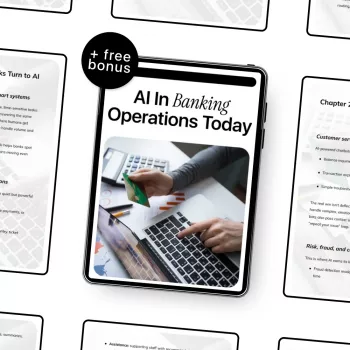
Our team offers AI in Banking Operations Today for modern banks and fintech teams interested in practical AI applications. The listed price is $6.99; visit the product page for current purchase details.
If you are also considering how employees can work alongside changing technology, our Sharpen What Can’t Be Automated ebook offers a related perspective on employee skills and AI.
Take the Next Step
Start by identifying one operational challenge and the people responsible for its performance and risks. Bring workflow owners, reviewers, and relevant control teams into the conversation before choosing a tool. You can explore our guide as a starting point for learning more about AI in banking operations.
Before choosing, compare the product details with your daily routine, available space, care needs, and preferred setup. The strongest option is usually the one that fits the intended use clearly and remains simple to clean, store, and check before repeat use.
FAQ
What can AI be used for in banking operations?
AI can assist with document processing, customer-service responses, transaction alert prioritization, and operational reporting. These uses still need appropriate validation and human oversight.
Does using AI remove the need for human review?
No. Human accountability and review remain important, especially when outputs inform sensitive or consequential decisions.
Who is AI in Banking Operations Today for?
It is a guide for modern banks and fintech teams interested in practical applications of AI in banking operations.











Leave a comment